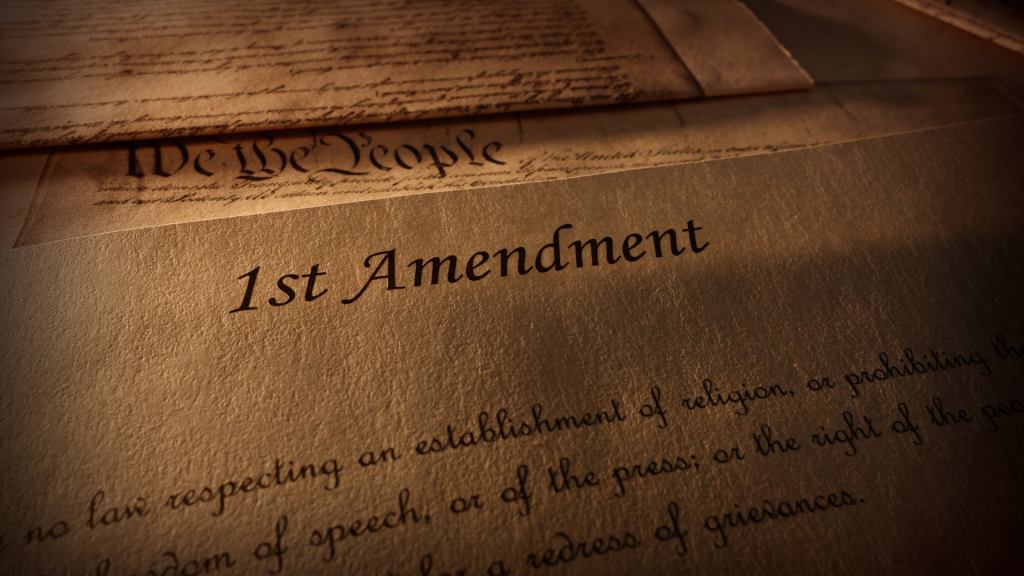
What the First Amendment Says
The First Amendment to the United States Constitution, ratified on December 15, 1791, is one of the most important sentences in American history:
“Congress shall make no law respecting an establishment of religion, or prohibiting the free exercise thereof; or abridging the freedom of speech, or of the press; or the right of the people peaceably to assemble, and to petition the Government for a redress of grievances.”
In just a few words, the Founders built a permanent shield for personal liberty against government overreach.
Why Freedom of Speech Is Essential
Without free speech, there is no true freedom. Debate, criticism, and open dialogue are how ideas are tested, truth emerges, and society improves.
President Harry Truman once said:
“Once a government is committed to silencing the voice of opposition, it has only one way to go, and that is down the path of increasingly repressive measures.”
Silencing voices doesn’t make us safer, it makes us weaker.
Modern leaders echo the same principle. Charlie Kirk often emphasizes that:
“Free speech is the cornerstone of our Republic. Without it, every other right crumbles.”
Freedom of Religion
The First Amendment also secures freedom of religion, both the right to worship openly and the assurance that the government cannot impose a national religion.
This is exactly what the colonists fought to escape from: persecution and forced belief. By guaranteeing religious freedom, America became a nation where faith is personal, not political mandate.
A Free Press
The Founders also knew that power must always be questioned. That’s why they protected the press, even when the press criticizes leaders.
Thomas Jefferson famously wrote:
“Our liberty depends on the freedom of the press, and that cannot be limited without being lost.”
A free press acts as a check on authority. It gives the people the ability to hold leaders accountable.
Assembly and Petition
The right to gather and petition the government ensures that everyday Americans, farmers, business owners, teachers, and parents, always have a voice.
From the Civil Rights marches of the 1960s to peaceful rallies in our neighborhoods today, assembly has been the engine of change.
Respecting One Another
The First Amendment was never about silencing voices we dislike. It’s about protecting them, because if one voice can be silenced, so can yours.
President George Washington said it best:
“If freedom of speech is taken away, then dumb and silent we may be led, like sheep to the slaughter.”
Freedom works only when it is equal. That means listening, even when we disagree. Respect first. Judgment last.
Closing Reminder
We live in an age where words are often treated like weapons. But let’s remember the old saying:
“Sticks and stones may break my bones, but words will never hurt me.”
Words are not violence. Words are ideas. And ideas, when allowed to flourish, change the world.
So let’s guard our First Amendment. Let’s use it to build, not tear down. And above all, let’s listen.

 John Liter
Leave a comment